AS 2870 vs USCS Soil Classification: Which One Does Your Sydney Build Actually Need?
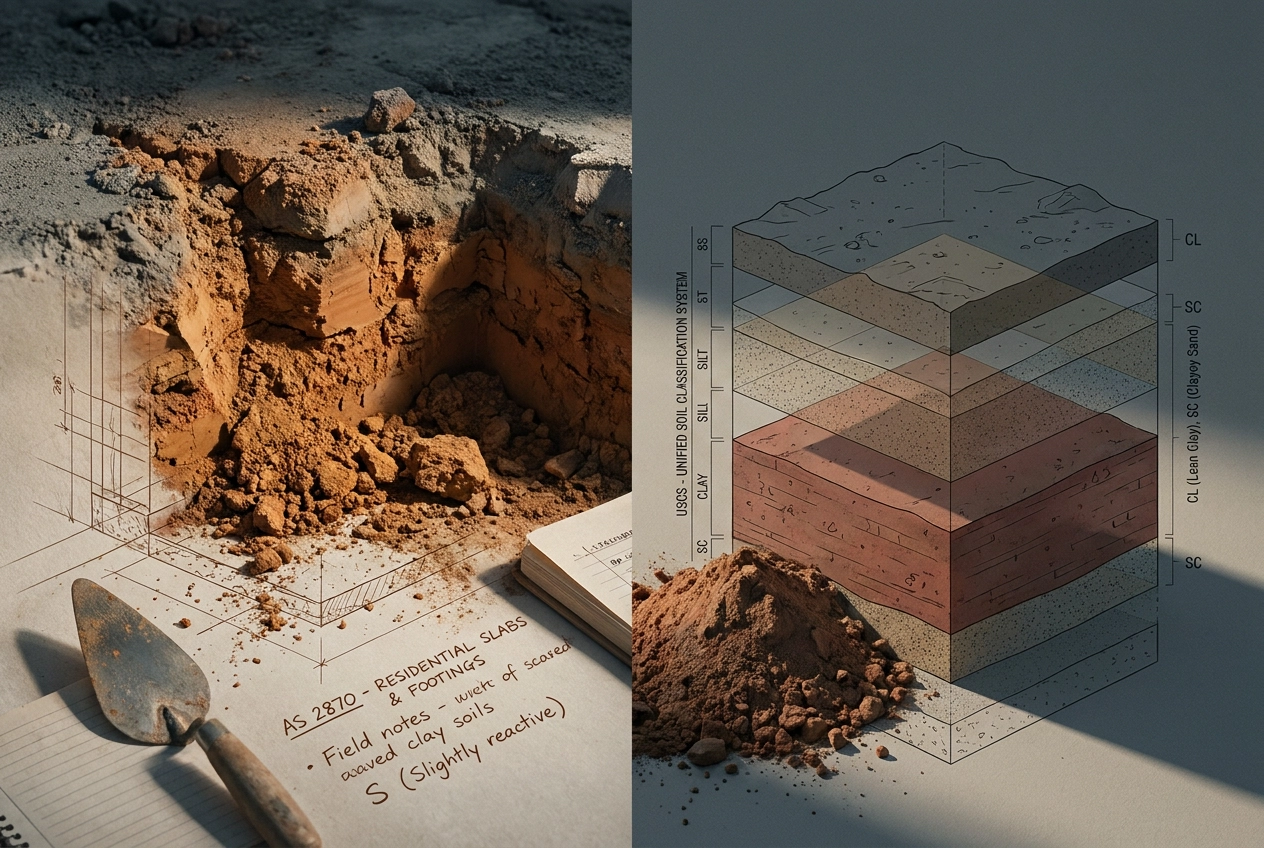
Getting your soil classification wrong before lodging a Development Application in NSW is not a minor administrative slip. It can stall your approval, trigger costly resubmissions, and in the worst cases, lead to a footing design that is fundamentally unsuitable for the site. Yet this exact mistake happens when developers confuse two distinct systems: the USCS soil classification and Australia's own AS 2870 standard.
The Unified Soil Classification System is a globally recognised framework used across civil engineering. AS 2870 is the mandatory Australian standard that governs residential footing design and site classification in NSW. They are not interchangeable, and NSW councils will not accept one in place of the other.
This post breaks down exactly what separates these two systems, why Australia developed its own classification approach, and what your council actually requires at DA lodgement. You will also find a direct comparison of both frameworks, a plain-English guide to AS 2870 site categories, and clarity on the narrow circumstances where USCS reporting is relevant in Australia. If you are building in Sydney, this is the distinction that matters.
The Real Cost of Using the Wrong Soil Classification System
Submitting the wrong soil classification report to a NSW council is one of the most avoidable causes of DA delays, yet it happens regularly. When a council assessor receives documentation that does not include a valid AS 2870 site classification, the application enters a resubmission queue. That process alone can set a project timeline back by weeks, and in competitive Sydney markets, weeks compound into real financial exposure.
The costs stack up faster than most developers anticipate. Additional consultant fees to prepare the correct report, resubmission charges, holding costs on the site, and potential downstream contract penalties can collectively turn a minor documentation error into a significant budget problem.
The confusion often starts with USCS terminology, developers reasonably assume it covers the same ground as AS 2870, but a compliant NSW residential DA requires AS 2870 classification specifically, not a USCS report.
The distinction is not technical fine print. It is the difference between documentation that clears lodgement and documentation that gets returned for amendment.
Understanding which system applies to your project, before you lodge, is the single most reliable way to avoid this category of cost. Our more guides cover the full DA documentation requirements in detail.
What Is the Unified Soil Classification System (USCS)?
The Unified Soil Classification System is an internationally recognised framework standardised through ASTM D2487 for broad civil engineering use worldwide.
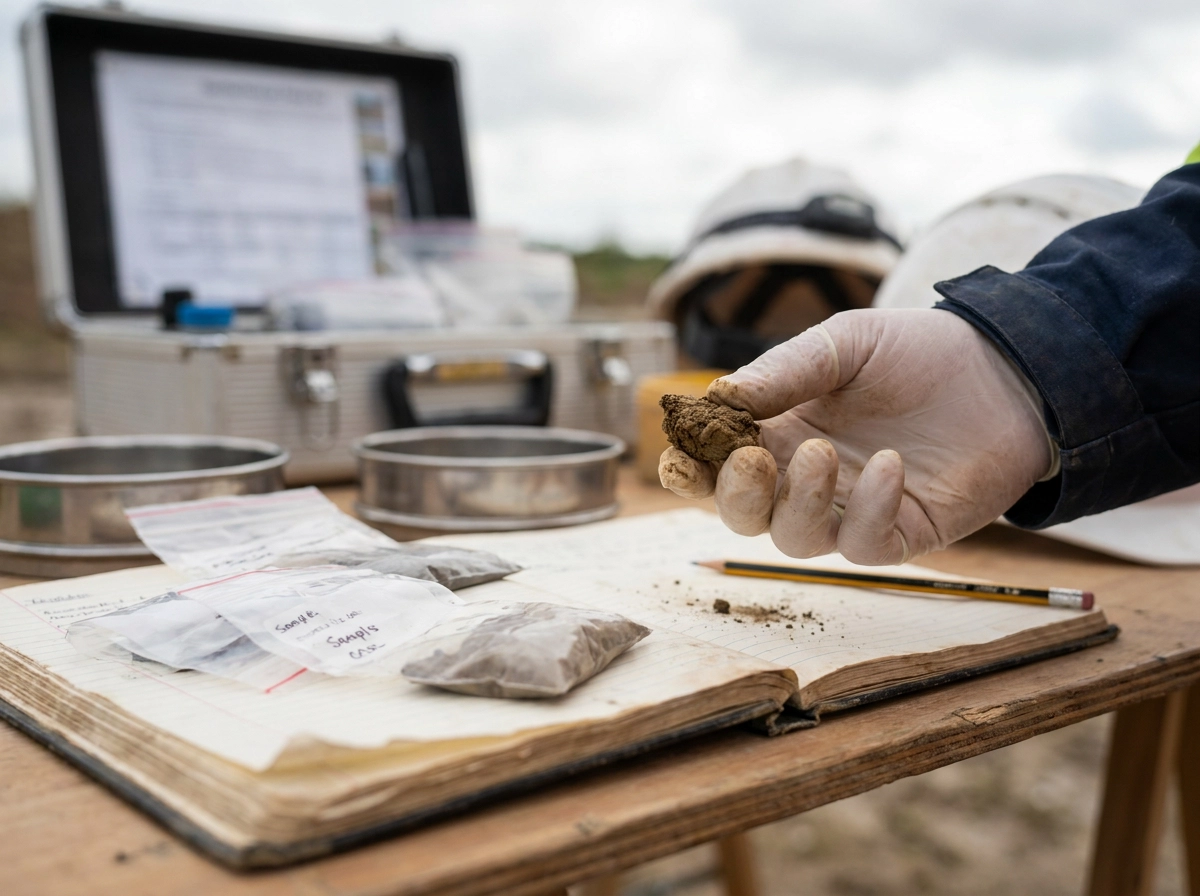
The system categorises soils by particle size distribution and plasticity, producing two-letter codes that describe soil type. Common designations include GW (well-graded gravel), SM (silty sand), and CH (high-plasticity clay). These codes are derived from laboratory testing: particle size analysis establishes the proportion of coarse versus fine material, and Atterberg limits (liquid limit and plasticity index) refine the classification further.
USCS is built for infrastructure applications, specifically roads, embankments, dams, and large-scale earthworks, where the primary engineering concern is how a soil behaves under load or how it drains. It answers questions about bearing capacity and compaction, not about what happens to a clay profile when Sydney's summer drought gives way to winter rain.
That last point is the critical limitation. USCS has no mechanism for assessing reactive soil behaviour. It cannot quantify how much a clay will shrink or swell in response to moisture change, which is precisely what determines footing performance on Australian residential sites. The soil classes used in Australian residential design are built around that reactivity measure; USCS simply does not produce it.
Because USCS is referenced extensively in global geotechnical literature and is familiar to international contractors, it frequently appears in Australian project documentation. That familiarity is the source of the confusion, not any overlap in purpose.
What Is AS 2870 and Why Does Australia Have Its Own System?
Where USCS falls short is precisely where AS 2870 begins. Published by Standards Australia, AS 2870:2011 (Residential Slabs and Footings) is the mandatory standard governing residential footing design and soil classification for development applications across Australia. It exists because Australian conditions demanded something USCS was never built to handle.
Sydney and NSW soils contain highly reactive clay profiles that shrink during dry periods and swell when wet, sometimes by tens of millimetres across a single seasonal cycle. This behaviour is largely absent in the northern hemisphere environments where USCS was developed, so no provision for it exists within that system.
AS 2870 instead quantifies reactivity via the characteristic surface movement value (ys), something USCS cannot produce. That movement potential determines whether a slab will remain stable over its design life.
The standard works alongside AS 1726, which provides the methodology for soil and rock testing that generates the data AS 2870 needs to classify a site. AS 1726 is the testing methodology standard; AS 2870 is the classification standard. The two are complementary, not interchangeable.
The site classification AS 2870 produces is the document a structural engineer uses to determine what footing system is required, making it essential to the DA chain before design can proceed.
AS 2870 vs USCS: A Direct Comparison for NSW Developers
With the two systems introduced, the practical difference comes down to five criteria that matter directly to your DA.
AS 2870 | USCS | |
|---|---|---|
Purpose | Classifies reactive soil behaviour for residential footing design | Categorises soil engineering properties for broad civil applications |
What it measures | Clay shrink-swell potential and moisture change depth | Particle size distribution and Atterberg limits |
Output | A site class (e.g., H1) that prescribes footing design | A soil descriptor (e.g., CH) that informs analysis but prescribes nothing |
NSW regulatory status | Mandated by NCC Part 3.2.4 for residential footing and slab design | No standing in NSW residential DA documentation |
Who accepts it | Required by NSW councils for residential DA lodgement | Will not satisfy lodgement requirements |
Accreditation | Must be prepared by an accredited geotechnical consultant | No equivalent accreditation requirement |
The regulatory gap is the critical point. NCC Part 3.2.4 mandates AS 2870 classification for all residential footings and slabs; USCS appears nowhere in that framework. A USCS report, regardless of how technically thorough it is, does not answer the question councils are asking: what is the site's reactivity class, and what footing system does that require?
The output distinction matters equally. A USCS code like CH tells an engineer the soil is high-plasticity clay. An AS 2870 site class like H1 tells the structural engineer exactly what footing system to design. One describes; the other prescribes.
Accreditation reinforces this. AS 2870 assessments submitted for DA must be signed by an accredited geotechnical consultant. Self-assessed or non-accredited classifications are not accepted, regardless of methodology. For more on when a geotechnical report is required and what it must contain, the more guides section covers common DA scenarios in detail.
The AS 2870 Site Classification Categories Explained
Once you know that AS 2870 is the mandatory standard, the next question is practical: which class does your site fall into, and what does that mean for your footing design? For a full breakdown of how the classes work, the six categories are summarised below.
Class A (non-reactive): Sandy or rocky ground with negligible moisture change and minimal movement risk. This is the least restrictive classification for footing design.
Class S (slightly reactive): Slight moisture change with minor ground movement potential. Footing requirements are minimal compared with higher reactivity classes.
Class M (moderately reactive): Moderate clay profiles with meaningful ground movement potential. Footing design needs to account for differential movement, which typically means deeper or more reinforced systems than Class S.
Class H1 and H2 (highly reactive): Significant shrink-swell behaviour driven by high clay reactivity. H2 carries greater movement risk than H1. Footings must be specifically engineered to manage substantial seasonal movement cycles; standard footing tables are unlikely to be adequate without modification.
Class E (extremely reactive): Extreme ground movement potential. Where it occurs, specialist footing engineering is mandatory. Standard AS 2870 footing tables do not cover this class.
Class P (problem sites): Sites with abnormal conditions that require site-specific geotechnical investigation and individually engineered footing design, regardless of the site's reactivity level.
When Does USCS Soil Classification Actually Apply in Australia?
Those AS 2870 site classes govern every residential DA in NSW, but they are not the only classification framework a geotechnical consultant needs to understand.
USCS remains actively relevant in Australia for commercial and civil engineering work: road construction, retaining structures, embankments, and large-scale earthworks regularly reference USCS soil descriptors within contractor specifications and international design standards. A fill compaction specification on a commercial site, for example, may define acceptable materials using USCS codes such as GW or SM, with AS 1726 test results interpreted against those designations.
Projects involving international engineering firms, overseas funding, or internationally governed design codes may require USCS classification alongside Australian-specific documentation. Infrastructure work tendered to multinational contractors frequently falls into this category, where both frameworks appear in the same geotechnical report for different purposes.
For what we cover across residential and commercial sites, the critical distinction is this: USCS data may inform the broader geotechnical picture, but it cannot substitute for an AS 2870 site class in a NSW residential DA. This holds even where a project has both residential and commercial components. The DA documentation requires AS 2870 classification regardless of what else sits in the technical appendices.
Mixed-use and staged developments are where this distinction matters most practically. A consultant with competency in both systems can identify which standard governs each deliverable, keeping the residential DA compliant while satisfying any commercial or civil specification requirements running in parallel.
What NSW Councils Actually Require at DA Lodgement
When it comes to residential DA lodgement in NSW, the regulatory baseline is unambiguous. NCC Part 3.2.4 mandates site classification for all footings and slabs in Class 1 and Class 10 residential construction. NSW councils adopt NCC provisions directly into their development assessment frameworks, which means AS 2870 classification is a statutory requirement, not a discretionary best-practice recommendation.
NCC 2025 is now the current edition of the National Construction Code, with NSW progressively adopting its provisions. AS 2870 remains the foundational site classification standard under the updated code, and its status in DA submissions is unchanged.
A compliant geotechnical report for a NSW residential DA must contain four elements:
The AS 2870 site classification (e.g., Class M, H1, or P)
Borehole or test pit logs prepared under AS 1726
The characteristic surface movement value (Ys), derived from shrink-swell testing
Footing design recommendations consistent with the assigned site class
Reports must be prepared and signed by an accredited geotechnical consultant. What we provide for residential sites across Sydney reflects exactly this structure, designed to pass lodgement without amendment requests.
A report lacking an explicit AS 2870 classification will not progress through the DA queue without formal amendment and resubmission, creating delays and additional holding costs. A report that contains thorough USCS data but omits a clear AS 2870 classification will not advance through the DA queue. The classification must be explicit, correctly referenced, and prepared to the standard councils are required to check against.
Get the Right Classification Before You Lodge
Knowing what councils require is only half the equation; the other half is making sure your consultant delivers it.
The distinction between AS 2870 and USCS is not academic. One satisfies NSW council requirements for residential DAs; the other does not. Submitting the wrong classification does not trigger a minor correction, it triggers a resubmission, a fresh queue position, and the holding costs that accumulate while you wait.
AS 2870 site classification, prepared by an accredited geotechnical consultant under the NCC Part 3.2.4 framework, is the mandatory deliverable for any Sydney residential DA. USCS data may appear within a broader geotechnical report where a project has commercial or civil earthworks components, but it cannot stand in place of the AS 2870 site class in the residential DA documentation.
Geotechnical competency in general is not the same as demonstrated experience with Sydney council lodgement standards. A consultant who understands both is the one whose reports pass first time. For more guides on Sydney DA requirements and what compliant documentation looks like, the DA Site and Soil resource library is a practical starting point.
DA Site and Soil prepares council-ready AS 2870 geotechnical reports for Sydney residential and commercial development applications, drawing on 25+ years of experience with NSW council standards. Contact the team before your next lodgement to confirm your soil classification is right from the start.
Conclusion
Choosing between AS 2870 and USCS is not a matter of preference; it is a compliance requirement with real lodgement consequences. Getting this right before lodgement is the most reliable way to protect your project timeline and budget.
Get your soil classification confirmed before you lodge, not after a council referral forces the issue. Contact DA Site and Soil today to ensure your documentation is council-ready from the first submission.
Talk to a Sydney site & soil consultant
Fast turnaround on soil classification, geotech reports and DA site assessments across Sydney.