Geotechnical Report Sydney: What to Expect Working with a Local Consultant
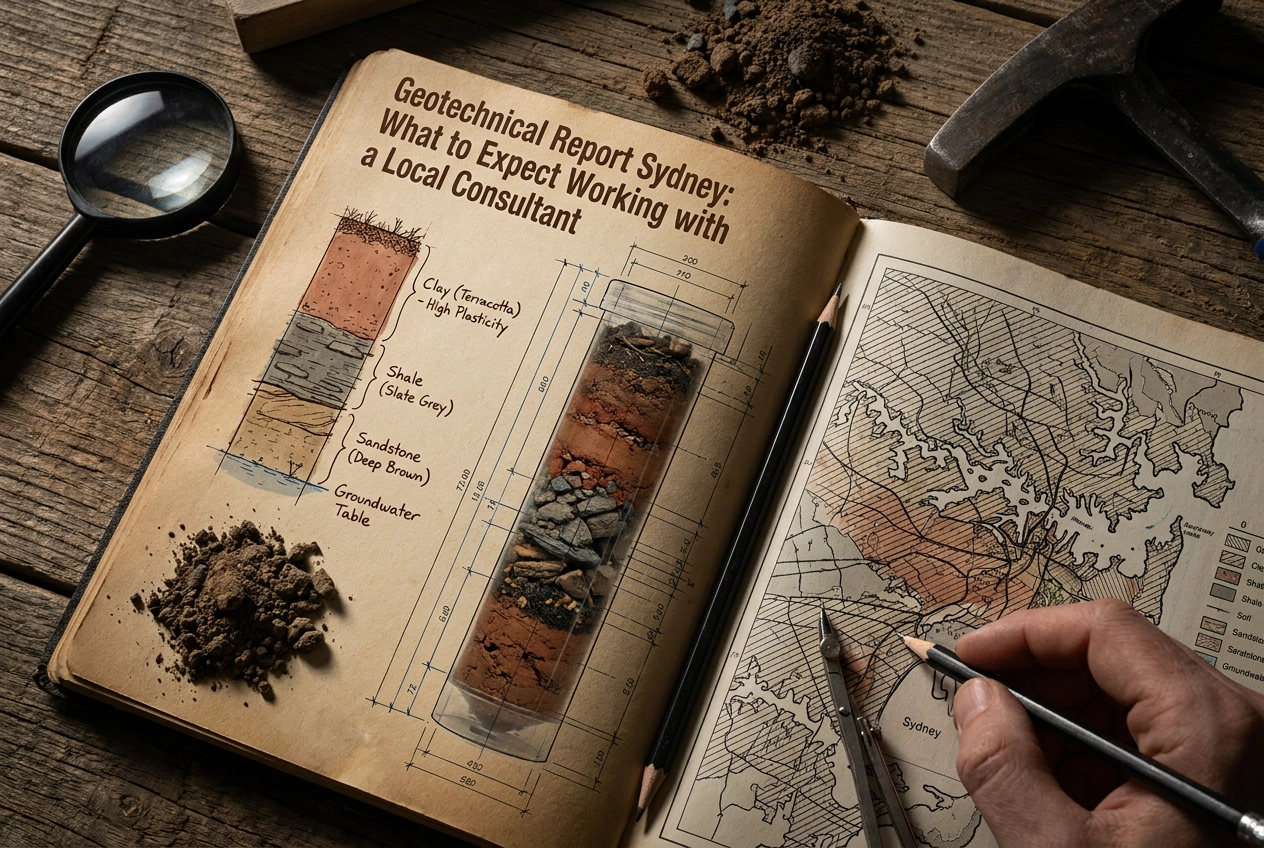
Dig a hole in Turramurra and you will hit solid sandstone within metres. Dig the same hole in Blacktown and you may find reactive clay that swells and shrinks with every season. That difference is not a minor detail. It determines how your footings are designed, how much your foundation will cost, and whether your development application sails through council or gets sent back with questions.
A geotechnical report Sydney property owners and developers need is not a generic document that any national firm can produce from a template. Sydney's geology shifts dramatically from suburb to suburb, and a consultant who understands those local formations will give you more accurate recommendations, fewer design revisions, and a report that council recognises as credible.
This guide explains exactly what makes Sydney's ground conditions so variable, walks you through the key geological zones you need to know, and shows you what a properly prepared geotechnical report should contain. By the end, you will know how to evaluate a local consultant with confidence and choose the right professional for your specific Sydney project.
Why Sydney's Geology Is More Variable Than Most Cities
Sydney does not sit on a single, predictable substrate. The Sydney Basin spans roughly 36,000 km² onshore and contains multiple distinct geological formations, each with fundamentally different engineering properties. Conditions can shift within a few kilometres, or within a single street.
Three dominant geotechnical zones define Greater Sydney:
Sandstone-dominated North Shore and Eastern Suburbs, underlain primarily by Hawkesbury Sandstone, a competent bearing material suited to conventional footing design
Shale and clay-dominated Western Sydney plains, where the Wianamatta Group produces expansive, moisture-reactive soils that behave very differently under load
Fill-prone river flats, where alluvial deposits and uncontrolled fill create low bearing capacity and settlement risk across major drainage corridors
This variability has direct engineering consequences. Footing recommendations prepared for a North Shore sandstone site are not transferable to a site 15 km west in Blacktown. Applying them without site-specific investigation creates real structural risk, not just a compliance problem.
The scale of the clay challenge is significant. The Wianamatta Group, comprising the Bringelly and Ashfield Shale formations, occupies approximately one-third of the Sydney geological sheet. Expansive clay conditions are therefore the dominant geotechnical challenge across a large proportion of Sydney development projects, particularly in Western Sydney.
Identifying which formation underlies a specific site is the starting point of any credible geotechnical investigation. That identification requires formation-level familiarity with the Sydney Basin, not just general geotechnical training. It is the core reason engaging Sydney soil and site consultants with local formation knowledge produces more accurate reports than engaging a generalist firm without it.
Hawkesbury Sandstone: The North Shore and Eastern Suburbs Advantage
Of the three dominant Sydney formations, Hawkesbury Sandstone offers the most favourable starting conditions for development. This medium to very coarse-grained quartz sandstone underlies much of the North Shore and Eastern Suburbs, extending to indicative depths of around 300 metres in places. As a competent, stable bearing layer, it is well suited to conventional strip footings, and sites founded on sound sandstone typically carry higher bearing capacity with lower movement risk than clay-dominated equivalents.
That combination simplifies footing design and tends to produce geotechnical reports with fewer complications at the council stage, making Hawkesbury Sandstone sites comparatively straightforward to develop when conditions are uniform.
Sandstone is not without its own risks, however. Rock that outcrops close to the surface increases excavation costs, particularly for basement construction. Weathered or jointed sandstone zones, where surface cements have been leached by groundwater, require careful assessment rather than a blanket assumption of competence. Steep North Shore topography adds slope stability considerations that must be addressed explicitly in the geotechnical investigation.
A consultant without specific Hawkesbury Sandstone experience can err in two directions: over-engineering a uniform rock site and inflating construction costs unnecessarily, or missing a localised weathered zone and leaving a genuine risk unassessed.
Local geotechnical experience resolves this. A consultant familiar with the North Shore knows where outcropping sandstone transitions to deeper weathered profiles suburb by suburb. That knowledge shapes the investigation scope from the outset, targeting effort where uncertainty actually exists rather than applying a uniform methodology regardless of what the formation is likely to show.
Bringelly and Ashfield Shale: Managing Expansive Clays in Western Sydney
Move west from the sandstone ridges of the North Shore and the ground beneath your project changes fundamentally.
The Bringelly Shale and Ashfield Shale, the Wianamatta Group formations introduced above, dominate the Cumberland Lowlands of Western Sydney and produce some of the most reactive soil conditions in the Sydney Basin. The core engineering problem is moisture sensitivity: clay-rich soils derived from these shale formations expand when wet and shrink when dry, creating significant ground movement that shallow or lightly reinforced footings cannot accommodate.
Under AS 2870 (Residential slabs and footings), sites are assigned soil reactivity classifications based on measured soil movement potential. A consultant who regularly investigates Wianamatta Group sites arrives with calibrated expectations about likely classification outcomes and designs an investigation to confirm or refine those expectations accurately. A consultant without that formation familiarity may default to a conservative worst-case classification, producing a more expensive footing specification than the actual site conditions justify.
The footing design consequences are concrete. Where sandstone sites may suit conventional strip footings, reactive clay sites require more engineered footing systems whose complexity, and cost, increases with soil reactivity classification.
Variability within Wianamatta Group soils adds another layer of risk. Reactivity levels are not uniform across Western Sydney, and localised shale close to the surface can affect both the site classification outcome and excavation planning. Missing that variability at the investigation stage leads to either an over-engineered design or, worse, a footing system that underperforms once construction begins.
River Flats and Fill-Prone Sites: The Risk Hidden in Western and Outer Sydney
Expansive clays present their own set of challenges, but a different category of risk altogether applies to sites along Sydney's major river corridors. Sydney's major river corridors have deposited extensive flat zones where the substrate is soft alluvial soil, estuarine material, or historical fill rather than any engineered founding layer.
These sites share none of the bearing characteristics of sandstone or shale. Expect low bearing capacity, high compressibility, and significant potential for differential settlement under load. Flood inundation risk is also a live engineering concern, not just a planning overlay, and must be addressed in both the geotechnical investigation and the DA site assessment.
Historical fill adds a further layer of unpredictability. Former industrial land and low-lying lots along river flats are frequently filled with material of unknown origin, composition, and compaction state. Standard bearing capacity assumptions cannot be applied to uncontrolled fill; why it matters becomes clear when variable fill produces differential settlement that compromises a structure long after construction is complete. Site-specific testing is not optional on these sites.
A properly scoped geotechnical investigation on a river flat must go beyond basic bearing capacity, addressing compressibility, potential for differential settlement, and flood inundation risk.
Consultants with direct Western Sydney experience bring contextual awareness of fill-prone corridors that shapes the investigation scope from the outset. That upfront recognition avoids the costly scenario of discovering unexpected fill mid-project and needing to expand the programme.
What a Sydney-Specific Geotechnical Report Actually Contains
Once you understand your ground conditions, the next question is straightforward: what should the report actually say?
A council-ready geotechnical report for a Sydney DA contains six core components: a site description and geological setting, investigation methodology (typically a combination of in-ground investigation techniques selected for site conditions), soil profile logs, laboratory test results, soil classification under AS 1726:2017 and AS 2870, and engineering recommendations covering footing type and design parameters.
The soil classification element deserves particular attention. NSW councils do not accept generic descriptors like "clay" or "sandy soil." Classification must conform to the relevant Australian Standard and be expressed in terms both the structural engineer and council assessor can act on. For residential sites, this means an AS 2870 site classification that directly drives footing system selection.
Formation familiarity sharpens this process. A consultant who knows a Blacktown site is likely to be moderately to highly reactive before fieldwork begins will design an investigation to confirm or refine that expectation. One without that background starts from scratch, increasing the risk of misclassification that either over-engineers the footing system or underestimates reactive movement.
Local consultants also anticipate council-specific triggers. Some Western Sydney councils apply particular geotechnical requirements to certain land zones; addressing these within the report can prevent post-submission information requests that delay DA decisions.
Reports from DA Site & Soil are structured for Sydney council DA processes and can incorporate erosion and sediment control plan requirements and DA site assessment components alongside geotechnical findings. To confirm what your specific site and council require before commissioning work, talk to a Sydney soil and site expert to map out the scope upfront.
Local Geotechnical Consultant vs. National Firm: What the Difference Means for Your Project
Knowing what a council-ready report should contain is one part of the equation. Choosing the right consultant to produce it is the other.
Formation-specific knowledge of the Sydney Basin is what prevents a geotechnical report from defaulting to conservative assumptions, and conservative assumptions have a direct cost. Over-specified footing requirements designed to account for uncertainty can meaningfully inflate construction costs that a targeted, formation-informed design would have avoided.
The less visible cost is time. A report that is vague on geological context, or that does not pre-address a specific council's submission requirements, is likely to attract a request for further information. Each council query extends the DA timeline and increases holding costs. For a developer, that delay rarely appears in the original consultant fee comparison, but it is very real in practice.
Local consultants who work regularly within Sydney understand what individual councils expect: the appropriate investigation depth, the right format, and the specific caveats that prevent follow-up queries. That knowledge comes from sustained practice in the local regulatory environment, not from general geotechnical qualifications.
DA Site & Soil has built more than 25 years of Sydney-specific experience across the full range of Basin formations, from North Shore sandstone to Western Sydney shale and outer suburban river flats. That depth of local practice, combined with established council familiarity, is what separates a report that moves a DA forward from one that stalls it.
If you are weighing up your options, talk to a Sydney soil and site expert about your specific site before committing to a consultant.
How to Evaluate a Sydney Geotechnical Consultant Before You Engage
Knowing why a local consultant matters is one thing; knowing how to verify it before you sign an engagement letter is another. These five questions will help you assess any Sydney geotechnical consultant quickly and confidently.
Ask about formation-specific experience. Request examples of investigations the consultant has completed in your suburb or the same geological zone. Experience with Hawkesbury Sandstone on the North Shore does not transfer directly to Wianamatta Group clay sites in Blacktown or Penrith. These are materially different engineering problems, and you want a consultant who has solved yours before.
Check professional credentials. Check that the consultant holds relevant professional engineering or soil science qualifications and is able to demonstrate experience with Sydney Basin formations specifically.
Confirm the report is structured for your specific council. Geotechnical report requirements are not uniform across Greater Sydney. A report that satisfies one council's checklist may not satisfy another's. Ask explicitly whether the consultant knows your council's current requirements and will tailor the document accordingly.
Ask about bundled services. A consultant who can deliver an erosion and sediment control plan and DA site assessment alongside the geotechnical report reduces coordination risk. All three documents will draw on the same site data, keeping findings consistent and reducing the chance of contradictions that trigger council queries.
Request a methodology explanation tailored to your site. A consultant who can clearly explain why they are proposing specific investigation methods for your site conditions, rather than reciting a standard scope, is demonstrating the formation-specific thinking that produces better outcomes. For a practical introduction to how soil classification works in this context, talk to a Sydney soil and site expert before finalising your brief.
Choosing the Right Geotechnical Consultant for a Sydney Project
The evaluation questions in the previous section point toward one organising principle: match formation experience to your site.
The key decisions, summarised:
Match your consultant's suburb and formation experience to your actual site geology
Confirm the report format aligns with your council's checklist before investigation commences
Verify that soil classification, DA site assessment, and erosion and sediment control plan requirements are all scoped together from the outset
For residential and commercial projects across Sydney, DA Site & Soil provides council-ready geotechnical reports, soil classification, DA site assessments, and erosion and sediment control plans. With more than 25 years of Sydney Basin experience across sandstone, shale, and fill-prone river flat sites, the practice is built specifically around the formation knowledge and council familiarity that DA approvals require.
The most effective next step is a site-specific conversation. Talk to a Sydney soil and site expert with your site address and proposed development type to confirm which formation is likely present and what investigation scope your project genuinely needs.
Conclusion
Sydney's geological variability is not a minor detail; it is the central factor shaping every geotechnical investigation, report structure, and DA outcome across the basin. The formation beneath your site determines investigation method, foundation design, and the level of council scrutiny your submission will face.
Four points carry the most weight: geology varies dramatically across Sydney suburbs; formation-specific experience in a consultant is not optional, it is essential; report structure must align with your council's requirements before investigation begins; and scoping soil classification, DA site assessment, and erosion and sediment control together avoids costly delays downstream.
Choosing the right consultant at the start of your project is one of the highest-value decisions you will make. Get the geology right, get the report right, and the rest of your approval process follows a far clearer path. Start that conversation today.
Talk to a Sydney site & soil consultant
Fast turnaround on soil classification, geotech reports and DA site assessments across Sydney.