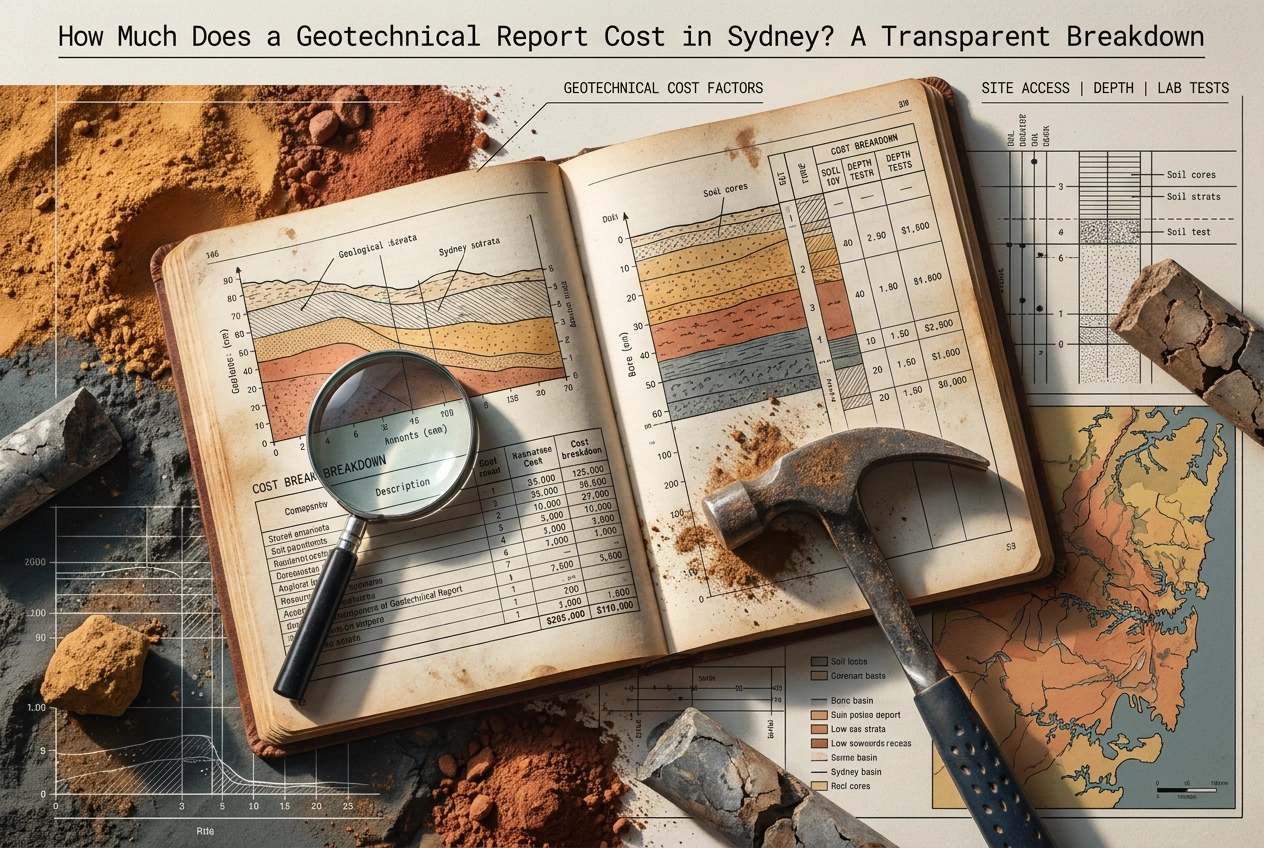
How Much Does a Geotechnical Report Cost in Sydney? A Transparent Breakdown
Getting a quote for a geotechnical report in Sydney and not knowing whether the figure you receive is reasonable is one of the most common frustrations developers face early in a project. The truth is, geotechnical report cost varies significantly depending on factors that most price guides never explain clearly: site access, soil reactivity, drilling depth, and the specific report type your project actually requires.
This post cuts through the ambiguity. Whether you are planning a residential build, an extension, or a more complex development, you will find a transparent breakdown of what drives costs in Sydney specifically, why national price benchmarks often miss the mark, and how to read a quote critically before signing off on it. You will also learn how AS 2870 soil classification affects your investigation scope, why urgency carries a premium, and why the lowest quote frequently leads to the highest overall cost when a report fails council review. By the end, you will have the knowledge to budget confidently, compare proposals fairly, and commission a report that is properly scoped for your site from the outset.
What Does a Geotechnical Report Actually Cost in Sydney?
In Sydney, a residential geotechnical report typically costs a few hundred dollars for a basic AS 2870 soil classification on a straightforward flat block and several thousand dollars for a full geotechnical investigation on a sloped or complex site.
For context, the national baseline for basic soil testing across Australia covers simple projects such as single-storey homes, extensions, sheds, and pools, with 2 to 3 boreholes at shallow depth. Sydney pricing sits consistently above that floor due to higher labour costs, council-specific reporting requirements, and the widespread presence of reactive clay soils across many suburbs.
That wide price range reflects genuinely different scopes, not simply margin variation between providers. A lower quote and a higher quote are rarely the same product; they almost certainly differ in borehole count, drilling depth, laboratory testing, and report detail.
Developers should treat unusually low quotes with real scepticism, a fee that seems too low for the scope almost certainly reflects missing boreholes, insufficient depth, or absent laboratory testing. If you are unsure what your site and council actually need, talk to a Sydney soil and site expert before accepting the lowest figure you receive.
Types of Geotechnical Reports and What Each One Costs
That wide price range exists because developers are often comparing entirely different products. Understanding the four main report types clarifies why quotes vary so dramatically.
AS 2870 soil classification is the report type commonly required for standard residential DA applications. It determines your site's reactivity class to inform footing design, and why it matters becomes clear at DA lodgement: without it, council won't approve your footing system. It is generally the lowest-cost option.
Phase 1 desktop assessment involves no physical site work. It reviews existing geological data, council records, and site history to flag potential issues early. Useful for feasibility, but rarely accepted as a standalone DA submission.
Phase 2 intrusive investigation involves physical drilling, sampling, and laboratory testing. It is required for multi-storey residential and commercial projects, sloped sites, and sites with suspected fill, contamination, or unusual geology. Costs rise accordingly.
Specialised reports, including slope stability assessments, retaining wall design investigations, and liquefaction assessments, attract the highest costs. These are triggered by specific site conditions or council requirements, not by project preference.
Identifying which report type your project and council actually require before requesting quotes is essential. Comparing an AS 2870 classification quote against a Phase 2 investigation quote is comparing different scopes entirely, a common source of developer confusion and budget miscalculation.
The Key Variables That Drive Geotechnical Report Cost
Building on the baseline scope noted above, six variables account for most of the price variation within any given report type.
Number of boreholes or test pits. Larger lots, irregular shapes, or suspected variability require additional investigation points, each adding direct fieldwork cost.
Drilling depth. The baseline depth suits many AS 2870 classifications, but fill, soft soils, or confirmed bearing capacity requirements may push depths well beyond the baseline. Deeper drilling takes longer and demands heavier equipment.
Laboratory testing. Index tests, Atterberg limits, particle size analysis, and consolidation testing each carry separate fees on top of site costs. Complex or reactive soils require a broader test suite, which compounds quickly.
Site access. Inner-city Sydney lots, narrow battle-axe blocks, and properties with restricted vehicle entry often cannot accommodate a truck-mounted rig. Hand-augering or compact equipment is slower and more labour-intensive, pushing fieldwork costs higher regardless of scope.
Soil complexity. Sites trending toward Class H2, E, or P classifications under AS 2870 require more thorough investigation to confirm the classification and support defensible footing recommendations. The more reactive the profile, the more work it takes to characterise it.
Council and certifier requirements. Some Sydney councils specify minimum investigation depths, engineer certification rather than geologist sign-off, or particular report formats. Private certifiers can impose similar conditions. These requirements extend preparation time and are a legitimate cost driver. See our cost and turnaround guide for how these factors interact with project timelines.
How AS 2870 Soil Classification Affects Your Investigation Cost
Those seven AS 2870 classes have a direct, predictable relationship to investigation cost.
Class A and S sites present stable to slightly reactive profiles with surface movement below 20mm, typically confirmed with 2 to 3 shallow boreholes and a standard lab suite, placing them at the lower end of Sydney's cost range. Class M sites sit in the moderate band and usually require minimal additional work beyond the baseline scope.
The cost curve steepens at Class H1 and H2. Highly reactive clay profiles are found across various Sydney sites, and confirming an H2 classification often requires deeper drilling and more thorough characterisation to support defensible footing recommendations.
Class E soils, defined under AS 2870 as extremely reactive, and Class P sites covering filled ground, soft soils, or sites with unusual features, carry the highest investigation requirements and therefore the highest costs. Site-specific conditions vary considerably, and higher classifications typically require deeper, multi-point investigation to support a defensible result.
Misclassification is not a minor administrative error. It creates professional liability for the certifying engineer and real structural risk for the builder. Reputable consultants scope to what the site demands, not to what keeps the headline fee low.
Sydney-Specific Cost Factors You Won't Find in a National Price Guide
Soil classification tells you what's in the ground. What it doesn't tell you is what your council will require once you try to build on it, and that gap is where Sydney's real cost variables live.
Council variation is the first factor national price guides ignore entirely. Sydney's many local government areas each apply their own geotechnical reporting standards within their DCPs and LEPs. Northern Beaches Council completed a dedicated Geotechnical Planning Controls review in 2024 as part of its LEP evidence base. Council-driven scope adds cost no generic quote anticipates.
Bushfire-prone land introduces further complexity. Bushfire-prone land overlays across outer Sydney and peri-urban areas can require coordination between geotechnical and bushfire assessments, affecting scope and fees.
Sloped sites are common across Sydney. Cut-and-fill proposals or steeper gradients routinely trigger slope stability reports extending well beyond standard soil classification.
Heritage and contamination overlays may trigger additional assessment requirements, including Phase 1 contamination screening, as a council condition before DA lodgement, particularly in older urban and former industrial areas.
Shallow rock compounds all of the above. Sandstone or shale at minimal depth can halt rotary drilling entirely, requiring alternative investigation methods at higher day rates and longer programmes.
If you want guidance on what your specific site and council will likely require, talk to a Sydney soil and site expert before requesting quotes.
Turnaround Time and How Urgency Affects the Price
Beyond the site-specific complexity covered above, timing is a cost variable developers frequently overlook until it becomes urgent.
Standard turnaround typically spans a few days to a few weeks between site investigation and final report delivery, reflecting laboratory processing queues and report preparation time, not consultant availability alone.
Laboratory testing is typically the rate-limiting step. Routine shrink-swell, Atterberg limits, and particle size tests move through standard queues; requesting priority processing is a direct additional charge passed through to you.
When a DA submission deadline is pressing or a construction programme is at risk, expedited turnaround is available, but expedited turnaround carries a meaningful premium above standard fees. That uplift covers priority lab scheduling and accelerated reporting, both of which displace other work in the consultant's workflow.
The most effective way to avoid that premium is to engage your geotechnical consultant early in the design phase, before lodgement pressure builds. If you are unsure whether your project requires a full investigation, reviewing whether you need a geotech report for your DA can help you plan the right scope at the right time.
Some consultants can also provide a faster desktop or preliminary assessment to inform early design decisions while the full investigation proceeds, reducing the risk of last-minute scope changes that compound cost and delay.
Why the Cheapest Geotechnical Report Is Often the Most Expensive Choice
An under-scoped report is a recognised cause of Sydney DA deferrals and RFIs.
Under-scoped reports, those with too few boreholes, insufficient drilling depth, or missing laboratory data, can stall a DA timeline by weeks or months and typically require a supplementary investigation that costs more than a properly scoped report would have cost at the outset.
The construction risk is equally real. A builder working from an under-scoped soil classification who encounters unexpected Class H2 or reactive conditions mid-build has no engineering basis to respond. The result is a footing redesign variation, an unbudgeted cost, and a programme delay.
On a $500,000 residential build, a $1,500 geotechnical investigation that prevents a $10,000 footing redesign variation is straightforwardly good value. Pre-construction soil testing cost should never be evaluated in isolation from total project exposure.
Reputable consultants with Sydney council experience scope investigations to what the site and council genuinely require. They will itemise why each element is included, not strip scope to produce the lowest headline figure. A quote that looks attractive because it omits a borehole or a lab test may cost significantly more before the project is finished.
How to Compare Geotechnical Engineering Report Costs Fairly
Require scope specifics in writing. Ask every provider to confirm the number of boreholes or test pits, drilling depth, laboratory test suite, and final report format. A lower quote and a higher quote are incomparable if one includes two shallow hand-augered holes and no lab testing while the other includes three machine-drilled boreholes with full Atterberg limits and shrink-swell testing.
Clarify what the quoted figure actually covers. Confirm whether GST, laboratory fees, and disbursements such as traffic control or specialised access equipment are included or will appear as additions on the final invoice. These items routinely add hundreds of dollars to a base quote.
Verify the certifying engineer's credentials. Check that the practitioner holds appropriate qualifications and current professional indemnity insurance. Some low-cost quotes come from unregistered practitioners whose reports Sydney councils will not accept, creating a costly restart.
Confirm council and standards compliance. Ask directly whether the scope satisfies the requirements of your specific Sydney LGA and AS 2870 for residential classification. See what you get with a properly scoped Western Sydney investigation as a useful reference point.
A provider with real Sydney council experience can scope precisely for your site, avoiding both unnecessary investigation and the under-investigation that triggers RFIs.
Getting a Scope-Matched Quote for Your Sydney Site
Once you have a clear framework for evaluating quotes, the next step is working with a consultant who can apply it to your specific site.
DA Site & Soil has been providing geotechnical reports and soil classifications across Sydney for over 25 years, with hands-on experience across the city's diverse local government areas and their varying submission requirements.
Rather than applying a flat rate, DA Site & Soil assesses each site individually, considering soil type, access constraints, slope, council requirements, and project type, before issuing a tailored, itemised fee proposal. That approach prevents both the over-scoping that inflates cost unnecessarily and the under-scoping that triggers council RFIs.
Services cover the full range of residential and commercial investigation needs:
AS 2870 soil classification for standard residential DA applications
Full geotechnical investigations for complex, sloped, or multi-storey projects
Slope stability assessments and erosion and sediment control plans
Earthworks compliance testing for commercial sites
Every report is prepared with Sydney DA submission requirements in mind, reducing the risk of supplementary investigation requests that extend timelines and add cost.
To receive a clear, itemised quote with no obligation, talk to a Sydney soil and site expert with your site address, project type, and target council. That is enough to get started.
Key Takeaways for Budgeting Your Geotechnical Report
Sydney residential geotechnical report costs span a meaningful range, and that spread reflects genuine scope differences. A basic AS 2870 soil classification on a flat, accessible block is a fundamentally different product from a full intrusive investigation on a sloped site with reactive clay or shallow rock.
The cost drivers covered in detail above, report type, borehole count, depth, lab testing, site access, and classification, all compound on Sydney sites.
The most useful way to evaluate the cost of a geotechnical report is against total project value and the consequences of an insufficient investigation. A council RFI triggered by an under-scoped report, or a footing redesign variation mid-build, will almost always cost more than the difference between a cheap quote and a properly scoped one.
Applying the comparison checklist above to every quote you receive is the surest way to avoid scope mismatches. Prioritise consultants with demonstrable, current experience across Sydney councils.
Sydney-specific overlays, covered in full above, add further cost that national guides ignore.
Talk to a Sydney site & soil consultant
Fast turnaround on soil classification, geotech reports and DA site assessments across Sydney.