
What Is an Erosion and Sediment Control Plan? A Plain-English Guide for Sydney Developers
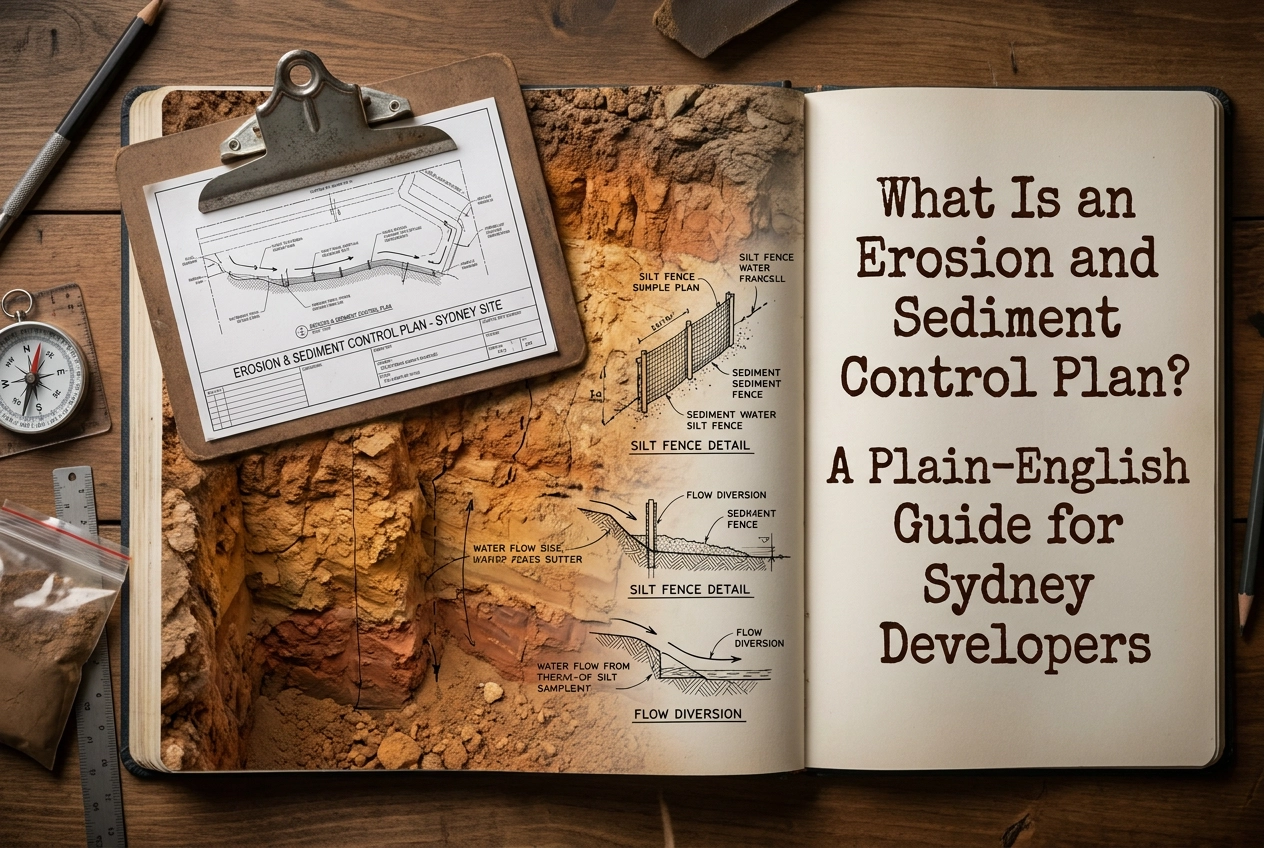
You've just opened your development consent conditions, and somewhere in the middle of all that planning jargon, three words have stopped you cold: erosion and sediment control plan. Maybe you've never heard of it before. Maybe you have a rough idea but no clue what it actually needs to contain. Either way, you need one before your project can move forward, and you need it to be right.
Here's the good news. An erosion and sediment control plan sounds far more complicated than it needs to be, and once you understand what it is and why councils require it, the whole thing becomes much less intimidating.
In this guide, we'll walk you through everything in plain English. You'll learn what the document actually is, what it must include under NSW requirements, why some plans get rejected or trigger stop-work orders, and how it fits into the broader Sydney development approval process. By the end, you'll know exactly what to look for before you approach anyone to prepare one for you. No engineering background required.

Why Your Council Is Asking for This Document
If your development consent arrived with a condition requiring an erosion and sediment control plan, you are not being asked to do something optional. Under NSW planning law, councils impose ESCPs as formal conditions of consent, meaning compliance is a legal obligation tied to your approval, not a recommendation you can decline.
The condition exists because of what happens on a construction site when it rains. Exposed soil washes off in runoff, carrying fine sediment into stormwater drains, local creeks, and coastal waterways. That sediment smothers aquatic habitats, degrades water quality, and contributes to the pressures the NSW Marine Estate Management Strategy 2018-2028 is designed to address. Council enforcement of your ESCP condition is the local delivery mechanism for that state-level water quality commitment.
The condition will typically require the ESCP to be approved before a Construction Certificate is issued, check your own consent documents for the precise wording. The construction certificate is what legally permits work to start on site, so an unapproved or deficient ESCP stops your project before a single shovel breaks ground.
The consequences do not stop there. If work commences without a compliant plan in place, councils have enforcement powers that can halt your project. That halts your entire site until the matter is resolved, with real cost and programme implications. Understanding why it matters from the outset is what allows you to treat the ESCP as a scheduled deliverable rather than a last-minute scramble.
What an Erosion and Sediment Control Plan Actually Is
So now you know why your council wants this document. Here is what it actually is.
An erosion and sediment control plan is a site-specific engineering document that maps out exactly how soil disturbance on your construction site will be contained and managed. Think of it as a control strategy for your dirt: it identifies where soil is at risk of moving, and specifies what physical measures will stop it from going where it shouldn't.
It is worth being clear on the two problems an ESCP is designed to solve. Erosion is what happens when soil particles are dislodged and carried away by water or wind during earthworks. Sedimentation is the downstream consequence: those particles settling in stormwater drains, nearby waterways, or on neighbouring properties. An ESCP addresses both.
What makes an ESCP different from a generic environmental checklist is that it is drawn to scale, tied to your specific site layout, and sequenced to match your actual construction programme. A templated document that ignores your site's topography, drainage flow paths, and soil types will not meet council's requirements.
Preparation requires a qualified consultant with geotechnical or civil engineering expertise. This is not a document a builder can draft from a standard template. If you want to understand the full scope of what that engagement covers, DA Site and Soil's Erosion & Sediment Control (ESCR) Reports outlines their approach.
If site conditions change or construction staging is revised, check with your certifier whether the plan needs to be updated.
What a Construction Erosion and Sediment Control Plan Must Include
So what actually goes inside the document? A compliant construction erosion and sediment control plan covers six core elements.
A scaled site plan forms the foundation. It shows the site's topography, natural drainage flow paths, and the exact location of every proposed control measure, including silt fences, sediment basins, and rock check dams. Generic diagrams that don't reflect your actual site will be rejected.
Drainage controls specify how stormwater and surface runoff will be intercepted, slowed, and filtered before reaching the site boundary. This includes diverting clean upslope water around disturbed areas and directing runoff through sediment-filtering devices rather than straight into stormwater drains.
Staged construction sequencing ties earthworks to the controls already in place. A typical requirement, consistent with NSW Water guidance, is that silt fencing and a stabilised site entry point must be established before any ground disturbance begins. The plan documents this order explicitly.
A revegetation and stabilisation schedule details how disturbed areas will be progressively stabilised as work proceeds, through turfing, seeding, or mulching. The goal is to minimise the window during which bare soil is exposed.
Inspection and maintenance protocols nominate who checks the controls, how often (typically after any significant rainfall event), and how defects get rectified. Missing this element is one of the most common reasons plans are rejected.
Contingency measures cover what happens if a control fails or a major storm hits mid-build. This might include emergency stockpile covering, secondary silt barriers, or an incident response contact list.
For a full picture of what we cover across site assessments and ESCP preparation, the scope goes well beyond ticking boxes on a standard checklist.
How ESCP Requirements Vary Across Sydney Councils
Knowing what your ESCP must contain is only half the picture. The other half is knowing what your council specifically expects, and those two things are not always the same.
In our experience working across Sydney LGAs, ESCP requirements are not uniform. The level of detail, preferred format, and specific controls a council expects can differ meaningfully from one local government area to the next, and a submission that satisfies one council can come back deficient from another. There is no single template that works everywhere.
The level of detail your council requires typically depends on several site-specific factors:
Site area and scale of earthworks, larger footprints disturb more soil and require more comprehensive controls
Slope gradient, steeper sites generate faster runoff and demand more intensive treatment
Proximity to waterways or drainage easements, sites near creeks, stormwater channels, or coastal environments face stricter sediment containment requirements
Development type, a multi-lot subdivision or commercial project with significant cut and fill will attract far more scrutiny than a single-lot residential build
Some councils reference the Landcom Managing Urban Stormwater: Soils and Construction guidelines (commonly called the Blue Book) as their benchmark. In our experience, others have their own templates or checklists that your submitted ESCP must address point by point. Submitting a plan that ignores a council's specific checklist is a common reason for first-submission rejection.
The ESCP is one of the documents you'll almost always need before a construction certificate is issued. Working with a consultant who knows your LGA's expectations from prior submissions is the most direct way to avoid the delays that come with going back and forth on revisions.
Common Reasons an ESCP Gets Rejected or Triggers a Stop-Work Order
Even when your ESCP is tailored to your council's general expectations, there are specific deficiencies that consistently cause plans to be rejected or, worse, trigger enforcement action once construction is underway. Knowing what assessors look for helps you avoid the most common and costly mistakes.
Templated or generic plans. Council assessors can spot a recycled plan quickly. If the sediment fence locations don't align with the actual slope and drainage paths on your specific block, the plan will fail. Every control shown must correspond to real site conditions.
Omitting inspection and maintenance schedules. This is a common deficiency. When it is missing, the site has no documented process for identifying and fixing control failures after rainfall, and that gap gives council grounds to reject the plan or act on a complaint.
Controls not installed before ground disturbance begins. Showing controls on paper is not enough. If construction is already underway without controls in place, you risk enforcement action. That halts your site until the matter is resolved.
Inadequate allowance for intense rainfall. Controls must account for intense rainfall events, not just typical conditions. Your plan needs to demonstrate that the measures specified can handle a significant storm, not just a light shower.
Incomplete construction sequencing. If the plan only covers early earthworks stages and later phases are left unspecified, the site has no documented controls once work progresses. Every stage needs to be addressed.
Ignoring soil erodibility. Soil erodibility varies significantly across sites; a plan prepared without site-specific soil knowledge may be inadequate. For a full picture of the technical reports your development may require, the technical reports your site needs is a useful reference before you engage a consultant.
Where an ESCP Sits in the Sydney Development Approval Process
Knowing why a plan gets rejected is useful, but it's equally important to understand when the ESCP needs to be ready in the first place.
The CC gate was explained earlier, what matters here is where ESCP preparation fits in the sequence of steps between DA grant and site start.
The practical sequence looks like this: development consent is granted first, then the ESCP is prepared once the site layout and construction methodology are confirmed. That sequencing matters because a credible ESCP must reflect your actual earthworks design, not a placeholder.
In some cases, for larger subdivisions or sites with significant environmental constraints, a preliminary ESCP may be required as part of the DA submission itself. This is less common for standard residential builds, but confirm with your council or certifier early if your site is near a waterway or involves substantial cut and fill.
Once construction begins, the ESCP does not go into a filing cabinet. It must be kept on site and made available to council inspectors on request. If conditions change mid-build, check with your certifier whether the plan needs updating. For a clearer picture of what's included in a professionally prepared ESCP, that context helps when scoping the work with a consultant.
Treat the ESCP as a scheduled deliverable with its own lead time, not a document you chase the week before you need the CC.
What to Look for When Getting Your ESCP Prepared
Once you know where the ESCP sits in your timeline, the next question is: how do you find someone who will prepare it properly?
Read the conditions of consent first. A competent consultant will ask to see your conditions of consent and any council-specific ESCP guidelines before touching a keyboard. If they quote you without reviewing those documents, that is a signal they are applying a generic template rather than a site-specific approach.
Insist on a site inspection. An ESCP prepared from architectural plans alone will routinely miss things that only show up on the ground: variations in soil type across the block, existing drainage paths running toward neighbouring properties, or retaining walls that affect how runoff moves. These gaps produce deficient plans.
Ask for examples of prior submissions in your LGA. Council expectations vary across local government areas, and a consultant who can point to approved ESCPs from your specific council will be better placed to match the format and level of detail that council expects, reducing first-submission rejection risk.
DA Site and Soil prepares council-ready ESCPs for Sydney residential and commercial developments, drawing on geotechnical site knowledge alongside an understanding of what individual Sydney councils expect to see.
Confirm ongoing support is included in the scope. If council requests amendments, or if conditions on site change mid-construction, the ESCP may need revision. Establish upfront whether your consultant will handle that, or whether it is an extra engagement each time.
Key Takeaways Before You Seek a Quote
Now that you know what to look for in a consultant, here is a quick summary of the essentials to carry into that first conversation.
An ESCP is a mandatory engineering document, not a form you fill in. NSW councils require it as a condition of consent to control soil and sediment during construction. It must be specific to your site, not adapted from a generic template.
The plan must address drainage, sequencing, revegetation, and inspection, all specific to your site and council.
In our experience working across Sydney LGAs, council expectations are not uniform. A consultant with direct experience in your local government area is better placed to get the plan approved at first submission.
A deficient ESCP has real consequences. It blocks your construction certificate before work begins and can trigger enforcement action once it has started. Either outcome adds cost and delay to your project.
Build it into your timeline early. The ESCP sits on the critical path between DA grant and site start, treat it as a scheduled deliverable, not an afterthought.
If your conditions of consent include an ESCP requirement, the team at DA Site and Soil can prepare a council-ready plan tailored to your site and LGA. Get in touch to discuss your project.
Talk to a Sydney site & soil consultant
Fast turnaround on soil classification, geotech reports and DA site assessments across Sydney.