
When Is a Geotechnical Report Required in NSW? A Developer's Trigger-Event Checklist
Getting the timing wrong on a geotechnical report can cost you weeks, sometimes months, in approval delays. Yet most developers only ask "when is a geotechnical report required" after a certifier or council officer flags it as a condition, by which point the project timeline has already taken a hit.
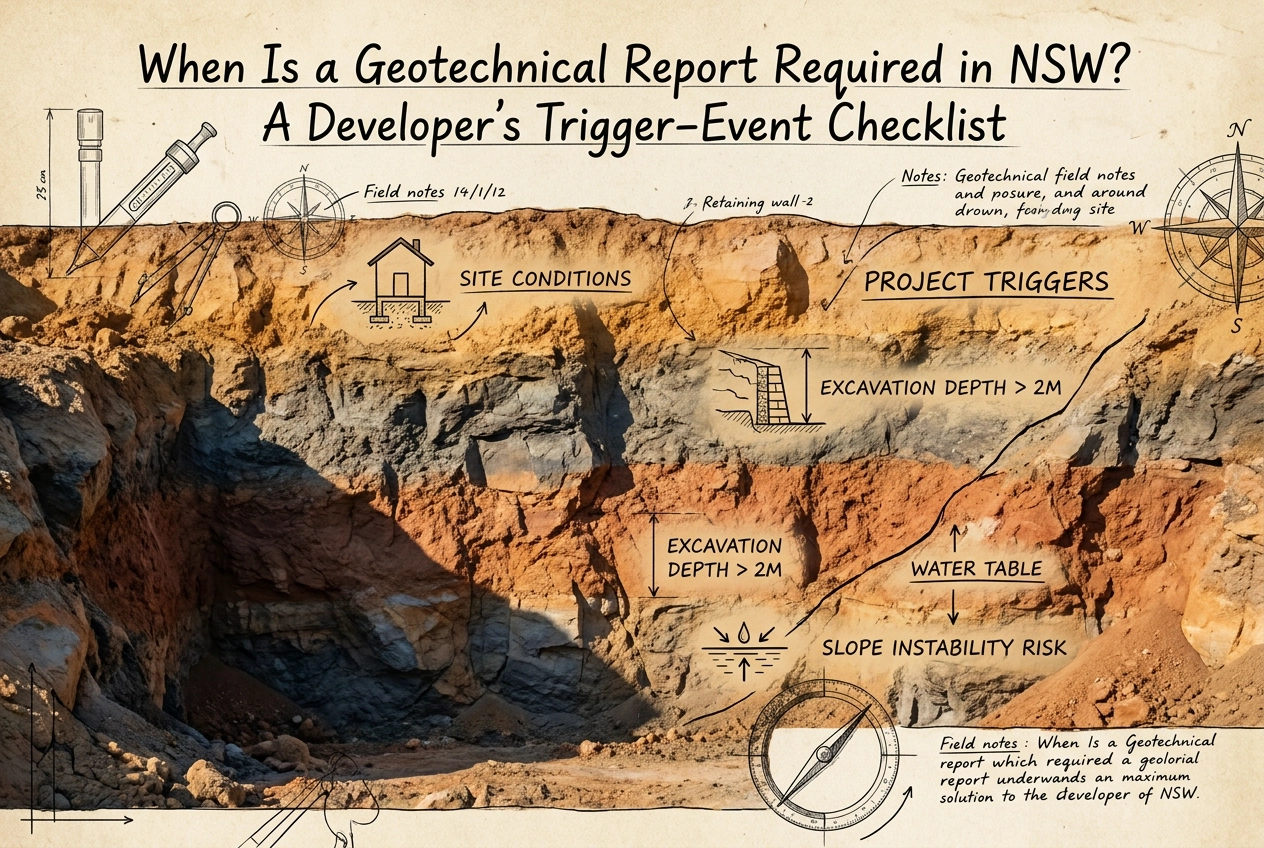
In NSW, the answer is rarely a blanket "always get one." Instead, the planning system identifies specific trigger points where a geotechnical report moves from optional to essential. These triggers are tied to your site's characteristics, the approval pathway you are using, and the overlays that apply to your land. Steep blocks, reactive soils, flood-prone land, and complying development on Class H or P sites each carry their own thresholds and obligations.
This post cuts through the generic advice and gives you a practical, trigger-based checklist covering six distinct scenarios: DA lodgement, Construction Certificate conditions, complying development classifications, hazard overlays, retaining walls, and demolition on fill sites. By the end, you will know exactly which triggers apply to your project before you lodge a single document.
Why Timing Is Everything With Geotechnical Reports
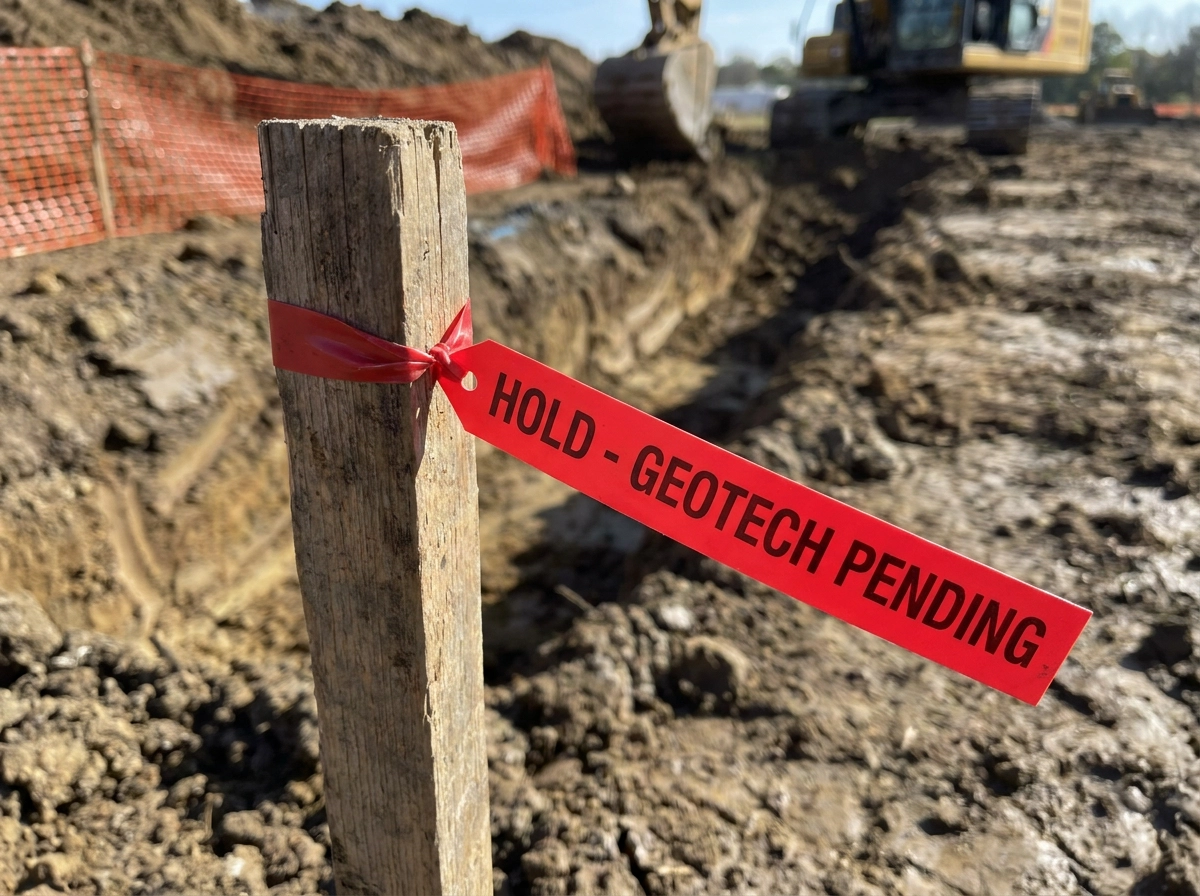
A geotechnical report requested after you've lodged your DA isn't just an inconvenience; it suspends your assessment clock and can add weeks or months to your approval timeline. The same applies at Construction Certificate stage, where a certifier's geotechnical condition becomes a hard stop on your build.
NSW planning operates across three assessment pathways: exempt development, complying development, and DAs requiring council consent. Each carries different geotechnical exposure points, and a site that qualifies for one pathway may be disqualified by soil or slope conditions that demand investigation first. Why it matters is most apparent when a developer assumes CDC eligibility, only to discover the site's soil classification blocks that pathway entirely.
The difficulty is that geotechnical triggers are scattered. Individual council LEPs and DCPs, SEPP provisions, and certifier conditions each carry their own requirements, and no single document consolidates them. What triggers a report in one LGA may not apply in another.
Pre-lodgement communication with council is the most effective point to identify these requirements, yet it remains underused. Raising geotechnical questions before formal lodgement costs nothing compared to a mid-assessment information request.
The six trigger events below cover the primary scenarios NSW developers encounter. Match them against your site conditions before you commit to any assessment pathway.
Trigger 1: DA Lodgement on a Steep or Reactive Soil Site
Slope gradient is the most common DA-stage trigger across Sydney councils. Most require a geotechnical report where a site gradient meets or exceeds 1:4 (approximately 15 degrees), though individual Development Control Plans set their own thresholds. Check your council's DCP before lodging, not after.
Reactive soil classifications create an independent trigger. Under AS 2870, sites classified Class H1, H2, or P exhibit high ground movement or problem soil conditions that make standard footing designs unsuitable. If your site falls into one of these categories, a geotechnical investigation is required regardless of slope.
A DA-stage geotechnical report on either site type typically needs to address three things:
Slope stability under the proposed building load
Footing system recommendations appropriate to the soil conditions
Cut-and-fill constraints that will govern earthworks design
Submitting this report with your DA application, rather than waiting to be asked, directly reduces your exposure to a section 8.3 information request. That notice suspends the assessment clock, and on complex sites it can add weeks to your timeline. Demonstrating upfront that site suitability has been assessed removes the most common reason councils issue one.
DA Site & Soil prepares council-ready geotechnical reports structured to satisfy DA submission requirements for sloping and reactive sites across Sydney, including slope stability assessments where the gradient warrants one.
Trigger 2: Construction Certificate Conditions Imposed by Your Certifier
Even when your DA sails through without a geotechnical condition, your certifier can impose one before issuing the Construction Certificate, a common source of late-stage delays developers don't anticipate.
Certifiers typically trigger this condition where:
DA plans show significant cut or fill
Footing documentation references variable or unknown ground conditions
The site falls within a mapped hazard area not fully resolved at DA stage
The NSW Planning portal confirms that developers "may be required to first provide additional reports" as covered in their DA consent conditions, making this a legally established hard stop on your CC.
A CC-stage report must go further than a DA-stage assessment. Certifiers require specific footing design confirmation, earthworks specifications, and bearing capacity data. A preliminary soil report scoped for DA suitability will not satisfy these requirements.
Addressing geotechnical work during the DA phase prevents costly structural redesigns once construction documents are finalised.
Read your DA consent carefully. If it contains language such as "prior to the issue of a Construction Certificate, a geotechnical report prepared by a suitably qualified engineer must be submitted," that condition is non-negotiable. Not sure whether your project needs to resolve this at DA stage? The guide on whether your DA needs a geotech report covers the key questions to ask before lodging.
Trigger 3: Complying Development on Class H or P Land
The CDC pathway looks straightforward until soil classification blocks it entirely.
Under the State Environmental Planning Policy (Housing) 2021, both the Housing Code and the Low Rise Housing Diversity Code permit complying development certificates for eligible residential builds. However, site classification under AS 2870 acts as a gatekeeping condition. Where a site carries a Class H (high reactivity) or Class P (problem soil) classification, standard footing designs referenced in the CDC pathway are not appropriate, and CDC eligibility is blocked or conditioned as a result.
A certifier cannot lawfully issue a CDC on a site where H or P classification is suspected without a geotechnical investigation confirming soil classification first. This is not a discretionary step.
A soil report tells you whether CDC is genuinely available or whether you need a DA with a custom footing design. What this means for your build depends heavily on which classification your site carries.
Sites most exposed to H and P classifications include:
Western Sydney and the Hills District, where Wianamatta Group reactive clays are widespread
Land near drainage lines or former agricultural areas with filled sections
Any site where previous soil testing has flagged variable or reactive ground
Identify your soil class before you engage a certifier, not after.
Trigger 4: Sites Within Flood or Landslip Hazard Overlays
Overlay mapping introduces a different category of trigger. Where soil classification gates your CDC pathway, flood and landslip overlays operate within the DA framework itself, and non-compliance is grounds for refusal.
NSW councils embed flood-prone land and landslip hazard areas directly into their LEPs and DCPs. When your site falls within one of these overlays, a geotechnical investigation is typically a mandatory DA submission requirement, not something a planner may or may not request.
Landslip triggers are particularly concentrated across Sydney's northern suburbs, the Illawarra escarpment, Blue Mountains foothills, and sites underlain by Hawkesbury Sandstone. If your site sits in any of these localities, assume the overlay applies until confirmed otherwise.
For flood-affected sites, investigations typically need to address scour potential, bearing capacity under saturated conditions, and the suitability of any proposed cut or fill within the flood planning level.
To confirm overlay status before lodging, check your council's interactive LEP mapping system and cross-reference the NSW Flood Data Portal. Your section 10.7 planning certificate is also definitive; overlays affecting the site are listed in Schedule 4. If you are unsure when you'll need one, that certificate is your starting point.
One critical scoping note: a generic soil classification report will not satisfy council requirements for a landslip or flood-risk site. The investigation must be specifically scoped to address the hazard identified in the overlay.
Trigger 5: Retaining Walls Over Threshold Heights and Sloping Blocks
Retaining walls introduce a separate geotechnical trigger that catches many developers off guard, regardless of how straightforward the rest of the project appears.
Walls exceeding 600mm in height generally require a DA or, at minimum, a structural engineer's design. At that threshold, council or the certifier will require geotechnical input confirming retained soil pressures, bearing capacity, and drainage conditions behind the wall. For tiered systems or walls over 1 metre, most NSW councils require a geotechnical investigation report to accompany the structural design. The engineer needs subsoil data to design the wall safely; the certifier needs it to issue approval.
Sloping blocks add a parallel trigger. Where proposed cut or fill exceeds 1 metre, most DCPs require a geotechnical report independent of overall project scale. A standard single dwelling on an otherwise unremarkable site can trip this threshold if the earthworks volume qualifies.
What geotechnical work typically covers at this trigger:
Soil bearing capacity at founding depth
Lateral earth pressure coefficients for wall design
Stability of the cut face during construction
The trigger does not end at approval. Once earthworks are complete, compaction testing and fill verification are often required before the certifier will sign off on the structure. DA Site & Soil provides earthworks support and testing compliance across these stages. For a full picture of reports often required by site conditions, review your council's DCP earthworks provisions early.
Trigger 6: Demolition Approvals on Sites With Contamination or Fill History
Demolition looks simple on paper, but below-ground conditions can turn it into a geotechnical trigger before a sod is turned.
Sites with a fill history, prior industrial or commercial use, or buried structures such as fuel tanks, stormwater infrastructure, or basement foundations may require a geotechnical investigation before or during the demolition approval process. Under the Contaminated Land Management Act 1997 and the State Environmental Planning Policy (Resilience and Hazards) 2021 (which absorbed the former SEPP No. 55 on Remediation of Land), councils can require site assessment wherever contamination is reasonably suspected. At this trigger point, geotechnical and environmental site assessment frequently overlap, and a single investigation scope often needs to address both.
The practical value of geotechnical work at demolition stage extends beyond contamination. Fill depth, buried materials, and soil voids left by removed structures all affect footing design for the replacement development. Identifying these conditions early, rather than during excavation, is why it matters to investigate before demolition proceeds.
Two additional flags worth noting:
Heritage Conservation Areas cannot use the Code SEPP pathway. All HCA projects require a full DA regardless of size, which raises the likelihood of council requesting detailed sub-surface assessment.
Section 10.7(2) and (5) planning certificates record known or suspected contamination and fill. If your certificate carries either notation, commission a preliminary site investigation before lodging your demolition DA, not after.
Quick-Reference Checklist: Does Your Site Trigger a Geotechnical Report?
Run through each condition below and answer yes or no. A single yes means a geotechnical report is required or strongly advisable before you lodge.
Slope gradient. Is the site slope at or steeper than 1:4? Check your council's DCP for the precise threshold. Yes: a geotechnical report is required at DA lodgement.
Soil classification. Is the site in a known reactive clay zone, or has any soil test returned a Class H or P classification under AS 2870? Yes: a geotechnical investigation is required before CDC eligibility can be confirmed or a DA footing design finalised.
Construction Certificate conditions. Does your existing DA consent contain any condition using the words "geotechnical," "engineer's report," or "soil investigation" prior to the CC? Yes: this is a hard stop; the CC cannot be issued until the condition is satisfied.
Overlay mapping. Does your section 10.7 planning certificate or council LEP map identify a flood or landslip hazard overlay on the property? Yes: a geotechnical investigation scoped specifically to that hazard is required at DA lodgement, not deferred to CC stage.
Retaining walls or cut/fill. Are retaining walls over 600 mm proposed, or does the earthworks design involve more than 1 metre of cut or fill? Yes: geotechnical input is required to support structural design and obtain approval.
Site history. Does the site carry a fill, industrial, or demolition history, or does it fall within a Heritage Conservation Area that requires a full DA? Yes: commission a preliminary site assessment before lodgement.
What to Do Before You Lodge: Practical Next Steps
Once you've matched your site against the checklist, act in this sequence:
Run a desktop check first. Pull your section 10.7 planning certificate, open your council's DCP and search for slope, earthworks, hazard overlays, and geotechnical requirements, then cross-reference the NSW Planning Portal for applicable SEPP provisions. This costs nothing and confirms which triggers are live before you engage anyone.
Request a pre-lodgement meeting with council. A planner can flag site-specific geotechnical concerns before your consultant team has committed to a design. Late discovery is where real cost occurs.
Commission geotechnical investigation before final design, not after. Soil classification and footing recommendations must inform your structural engineer's design from the outset. Retrofitting findings to a completed design means redrawing documents and absorbing the fees.
Engage a consultancy that understands the DA or CDC pathway your project must satisfy. A report meeting engineering standards but not council's documentation requirements will still draw an information request. Understanding the technical reports your site needs within the correct approval pathway is what produces a council-ready outcome.
DA Site & Soil prepares council-ready geotechnical reports, DA site assessments, and soil classification reports across Sydney, backed by 25+ years of experience with the trigger events and documentation standards Sydney councils apply. Contact the team with your site address for a direct answer on what your project requires.
Know Your Triggers Before You Lodge
A geotechnical report is not automatically required for every NSW development project, but the triggers that do require one are precise, and missing them is costly. Steep gradient, reactive soil, hazard overlay, retaining walls, demolition history, and Construction Certificate conditions each create distinct requirements. No generic answer resolves them; only a site-specific and pathway-specific assessment does.
The pre-lodgement check is the single highest-value action you can take. Identifying which triggers apply before you lodge means your geotechnical work informs your design, your application is complete on first submission, and you avoid the late-stage information requests that suspend assessment clocks.
The six triggers covered in this checklist give you the framework. Matching them to your actual site conditions is where the real work begins.
If you are unsure which triggers apply to your project, the DA Site & Soil team offers a no-obligation assessment. Provide your site address and project type, and you will get a straight answer on what your application actually needs, before it costs you time at council.
Conclusion
Geotechnical reports in NSW are not a universal requirement, but the six triggers covered here are precise and enforceable. Steep gradients, reactive soils, hazard overlays, retaining walls, demolition histories, and Construction Certificate conditions each carry specific documentation obligations that can stall or derail an unprepared application.
The core takeaway is straightforward: identify your triggers before you lodge, not after. Early geotechnical assessment shapes better designs, produces complete first submissions, and eliminates the costly delays that come from late information requests.
Generic advice will not resolve a site-specific compliance question. Only a direct assessment of your land, your pathway, and your council's requirements will.
Use the checklist in this post as your starting point. Then take the next step. Confirm what your project actually needs before it reaches council, and lodge with confidence the first time.
Talk to a Sydney site & soil consultant
Fast turnaround on soil classification, geotech reports and DA site assessments across Sydney.